Security that survives my own bugs: six layers and their configs
Six layers in production, each built for the day the one above it fails: forced row-level security, logins that cannot bypass it, sealed containers, phone certificates, weekly restores.
How I keep a 322,000-line accounting system correct on my own: one save gate, append-only money, a hash-chained audit trail, real-database tests, and the audit that caught what they missed.
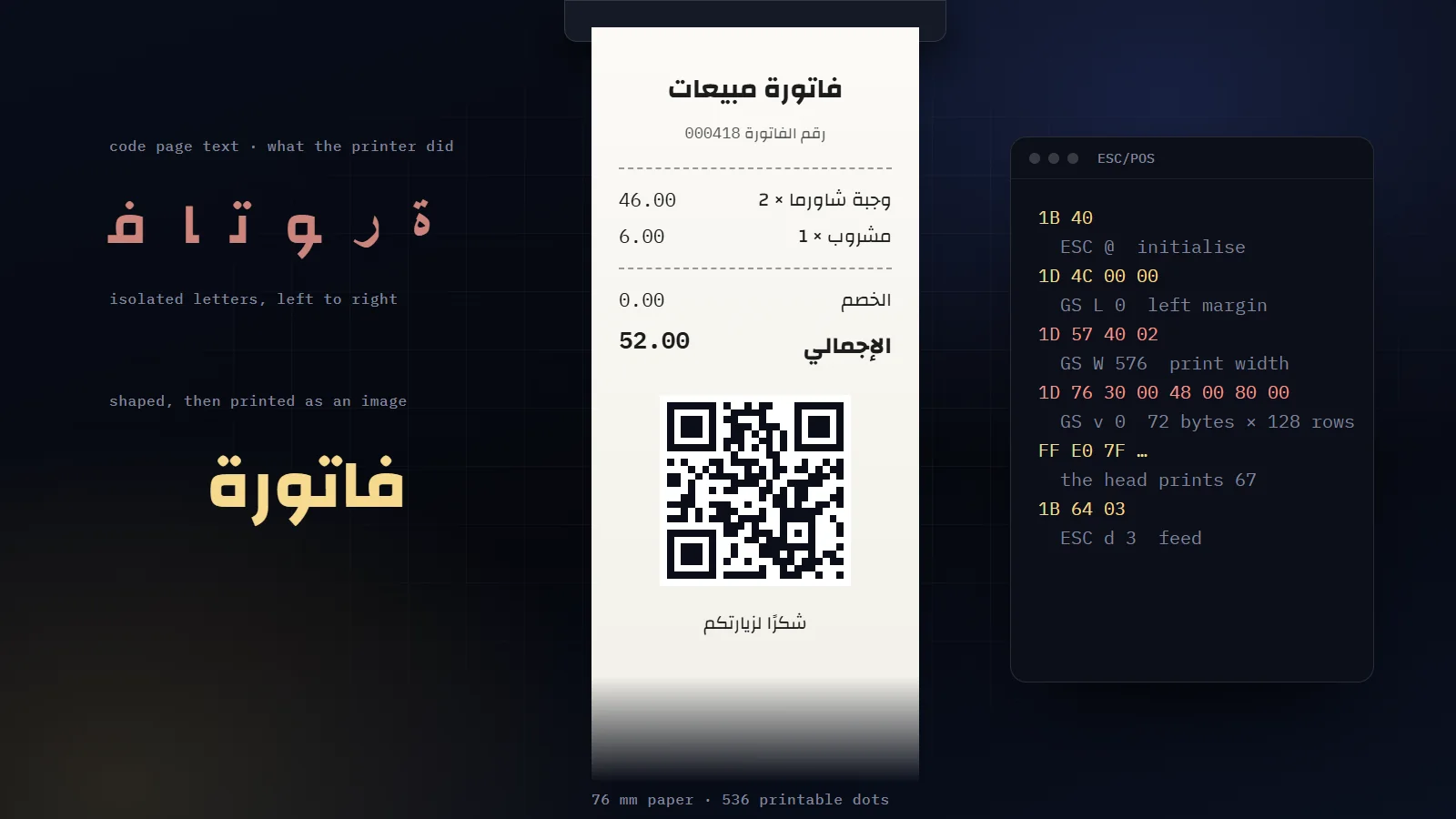
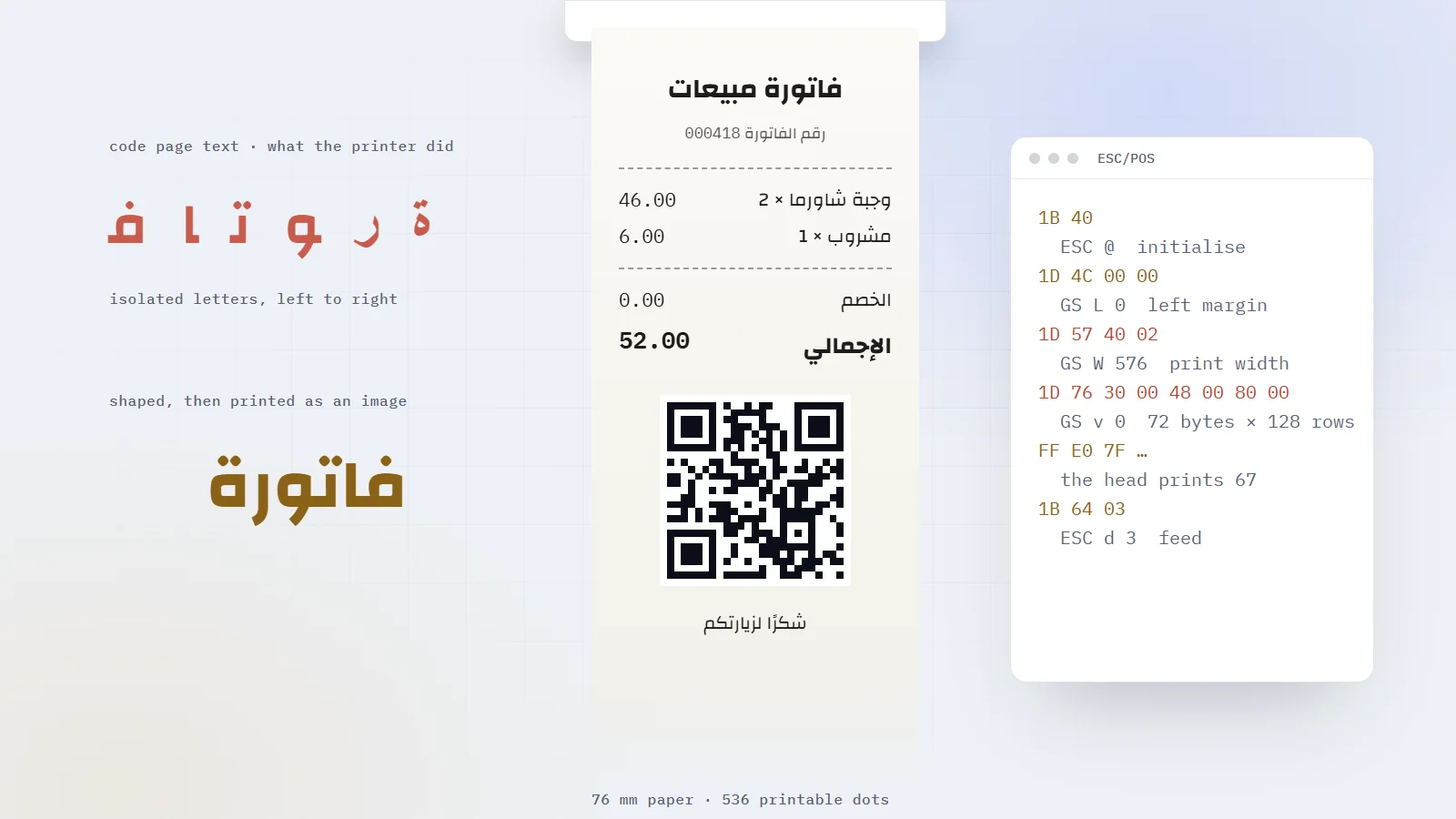
Why ESC/POS printers mangle Arabic, how to print it as a 1-bit image at the head's exact width, and the geometry bug that turned a 12 cm receipt into a roll on the floor.
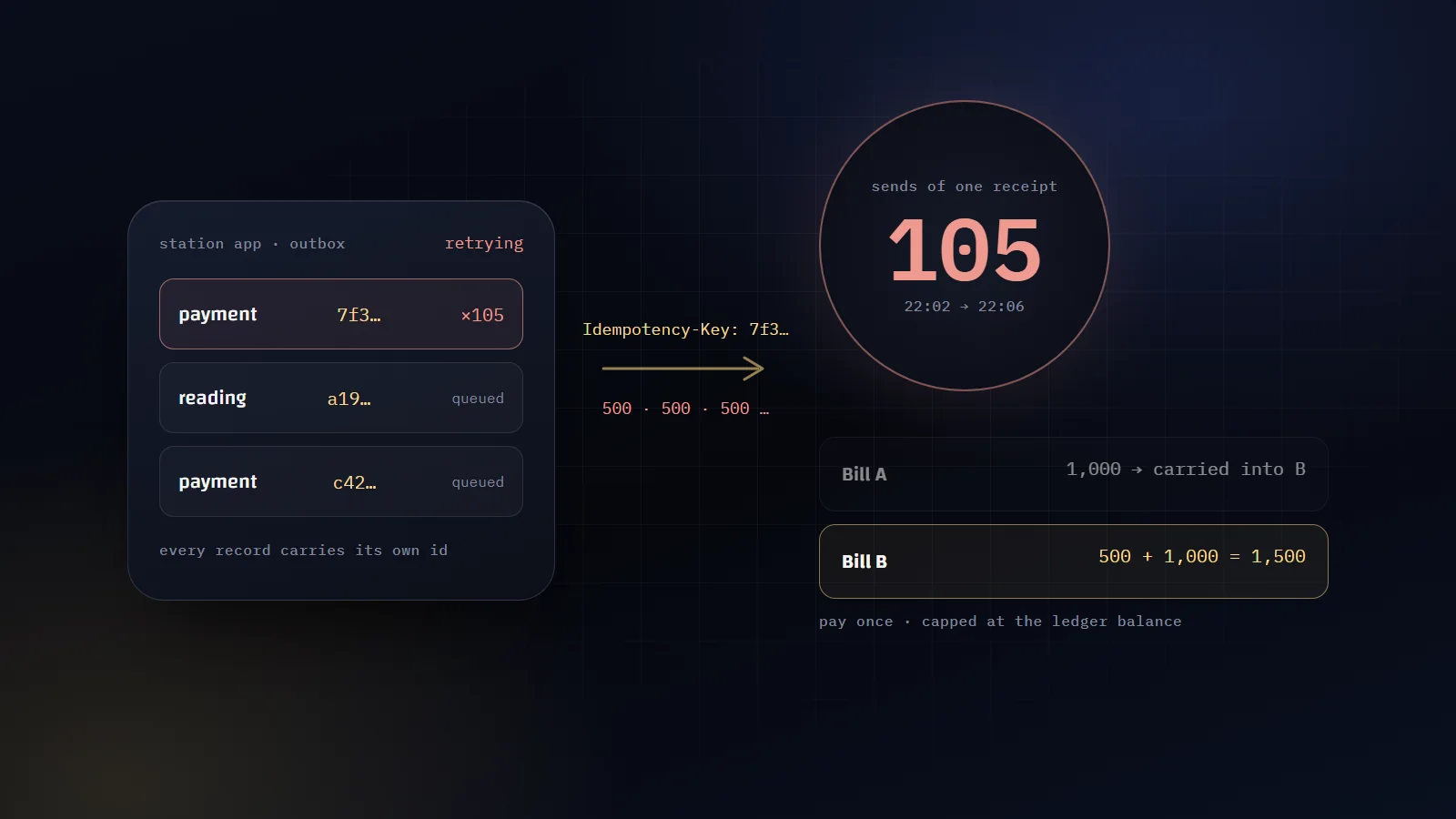
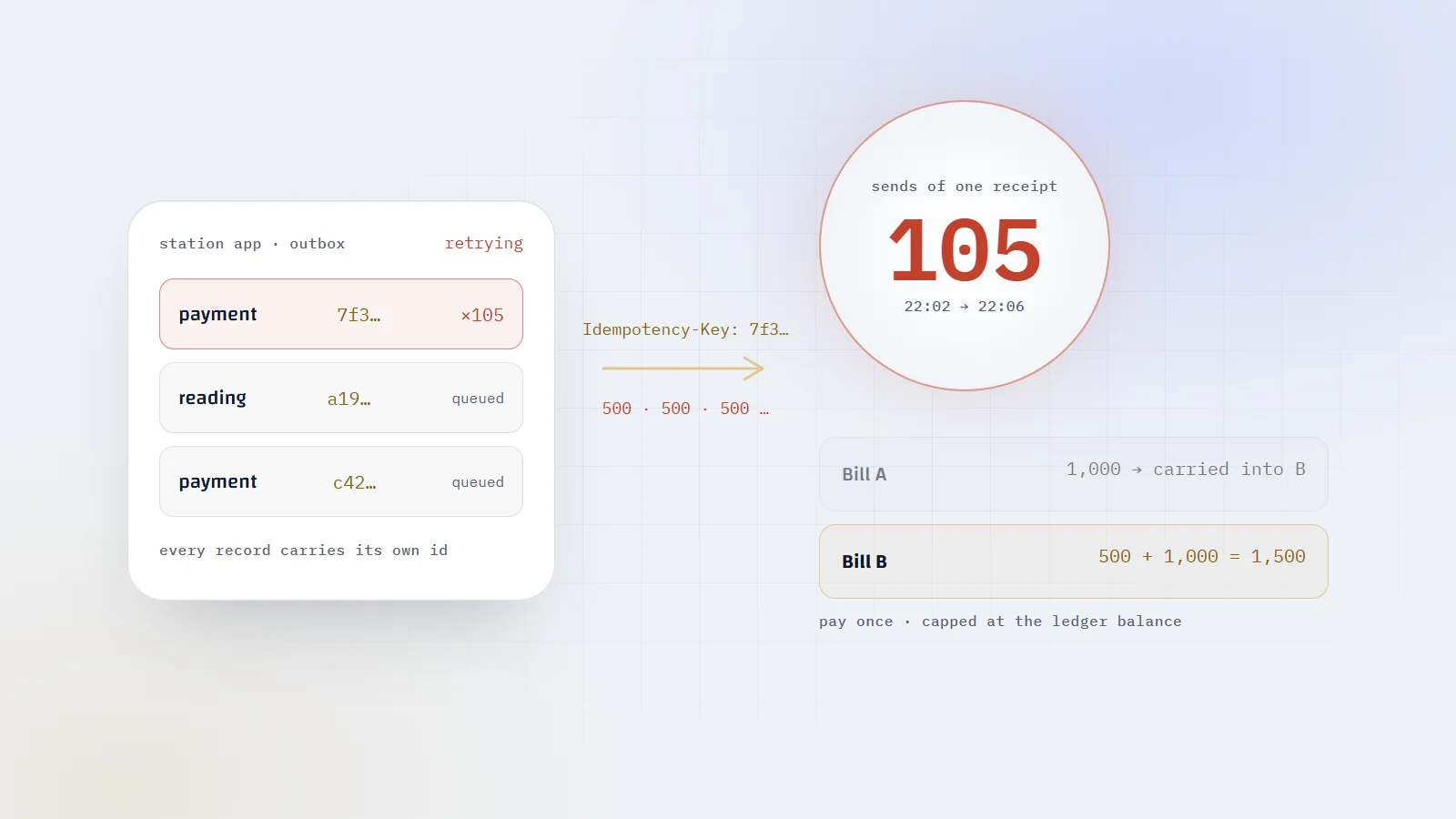
Offline-first billing for electricity stations: one id from the phone to the receipt, why bill totals must never be added, an outbox that knows what to retry, and the 500 that looped.
FinyxWatt, my platform for electricity and water stations, keeps the customers, bills and receipts of many stations in one PostgreSQL database. Every query its API sends is one missing WHERE tenant_id = ? away from showing one station's customers to another. I write those queries. One day I will forget the filter.
So nothing depends on me remembering it.
This is the field manual for how FinyxWatt and the server behind this site are protected: six layers, each built on the assumption that the layer above it has already failed. Every config comes from the real files, trimmed, without secrets or hostnames. By the end you can make PostgreSQL refuse a read your code forgot to filter, run containers that can barely do anything, give a phone an identity it cannot fake, and prove every week that your backup restores.
Three traps wait along the way: a PostgreSQL setting that comes back as an empty string, a header anyone could forge if one container joined the wrong network, and a retry default that lets a broken backup hold its own test hostage for hours.
6. Servera firewall for SSH, HTTP and HTTPS only, key-only SSH, automatic security updates
5. Front door (Caddy)HTTPS, security headers, closed admin paths, phone certificates
4. Containersread-only, no Linux capabilities, internal networks, secrets as files
3. APIverified tokens; the station comes from the token, never the request
2. Database rolesno superuser, no bypass, an insert-only ledger and audit log
1. Row-level securityevery row bound to an active membership of the user's station
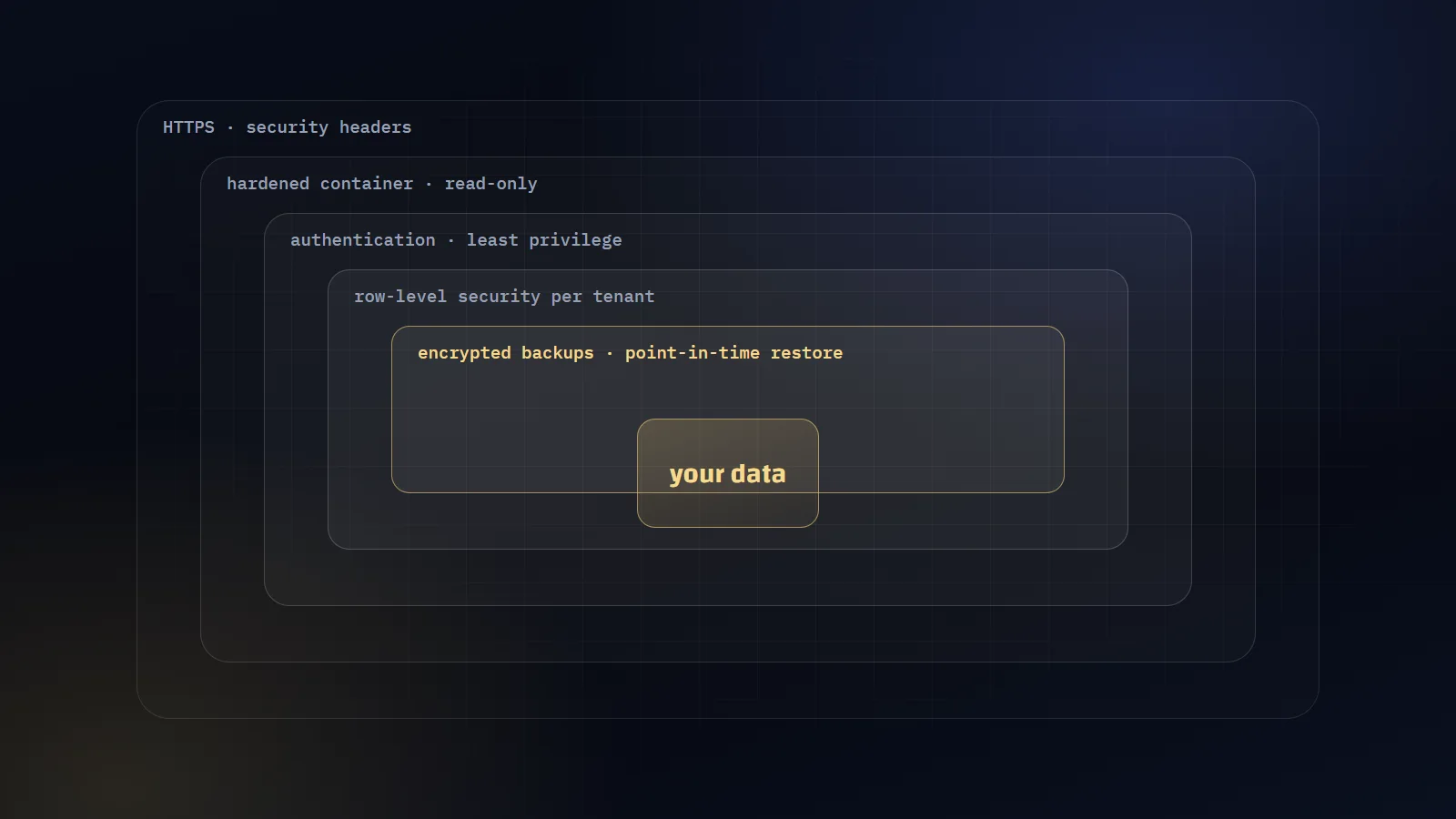
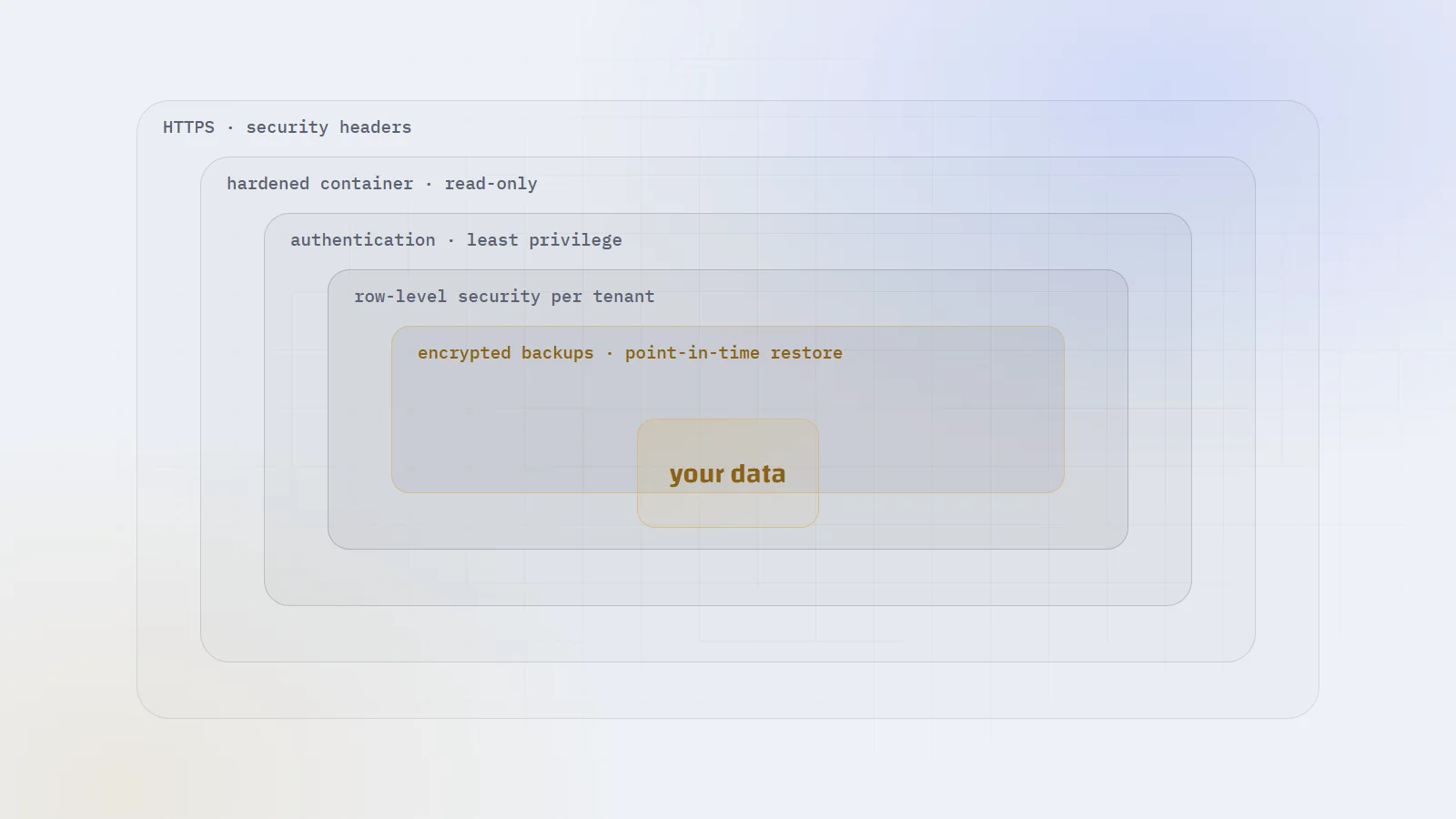
Six layers between the internet and the data, outermost first. This manual starts at the bottom, next to the data. Backups sit beside the stack.
The usual tenant boundary is a WHERE clause repeated in every query. It holds until one query, written in a hurry, leaves it out, and the bug is silent: the page works, it just shows too much.
FinyxWatt puts the boundary inside the database. Row-level security is enabled and forced on 88 of the 94 tables in its migrations. The six without it hold the permission catalogue, schema metadata and the bookkeeping of a one-time import. Every policy checks the row's station and that the user is an active member of it:
sql
ALTER TABLE invoices ENABLE ROW LEVEL SECURITY;ALTER TABLE invoices FORCE ROW LEVEL SECURITY;CREATE POLICY tenant_scope_api ON invoices FOR ALL TO platform_api USING ( tenant_id = app_private.current_tenant_id() AND EXISTS ( SELECT 1 FROM tenant_memberships m WHERE m.tenant_id = app_private.current_tenant_id() AND m.identity_id = app_private.current_identity_id() AND m.status = 'active' ) ) WITH CHECK ( /* the same condition */ );
The migration that added the membership check opens with its reason: "a future coding error must not turn a verified identity from tenant A into tenant B merely by setting a wrong transaction setting." A wrong station id finds no active membership, and the query returns nothing.
The API sets both values at the start of every transaction, from the verified token:
The final true makes the setting local to the transaction. A plain SET stays on the connection, and the pool hands it, still pointing at station A, to the next request.
The empty string is the first trap. On a new connection, a setting that was never defined reads as NULL. On a pooled connection that has already served a request, it reads as '', and ''::uuid throws. The helper every policy calls handles both:
sql
CREATE FUNCTION app_private.current_tenant_id() RETURNS uuidLANGUAGE sql STABLE PARALLEL SAFE AS $function$ SELECT nullif(current_setting('app.tenant_id', true), '')::uuid;$function$;
NULL equals nothing, so a request without context sees zero rows. It fails closed.
FORCE matters because a table's owner skips its policies by default. Superusers and BYPASSRLS roles skip them always. That is layer 2's job.
CI applies every migration to a fresh PostgreSQL and runs adversarial SQL tests as the API's own role. The core of one, ready to copy:
sql
SET ROLE platform_api;SET LOCAL app.tenant_id = '<station A>';SET LOCAL app.identity_id = '<an active member of station A>';DO $test$BEGIN IF (SELECT count(*) FROM customers) <> 1 THEN RAISE EXCEPTION 'RLS expected one station-A customer'; END IF; BEGIN INSERT INTO customers (tenant_id, subscriber_number, display_name) VALUES ('<station B>', 'ILLEGAL', 'Cross-tenant write'); RAISE EXCEPTION 'RLS accepted a cross-tenant write'; EXCEPTION WHEN insufficient_privilege THEN NULL; END;END $test$;
All of this assumes the API connects as a role the policies apply to.
Connect as the owner without FORCE, as a superuser or as a BYPASSRLS role, and every policy above is decoration.
FinyxWatt's database creates its logins on first start, "before the API image is ever allowed to connect", in the words of the script. Trimmed; the real one takes names from the environment and passwords from secret files:
sql
CREATE ROLE migrator LOGIN NOSUPERUSER NOCREATEDB CREATEROLE NOREPLICATION NOBYPASSRLS;CREATE ROLE api_login LOGIN NOSUPERUSER NOCREATEDB NOCREATEROLE NOREPLICATION NOBYPASSRLS;ALTER DATABASE app OWNER TO migrator;REVOKE CONNECT ON DATABASE app FROM PUBLIC;GRANT CONNECT ON DATABASE app TO migrator, api_login;GRANT platform_api TO api_login; -- the role every policy is written for
Only the migration login owns the schema. No runtime login holds a migration password, and the API runs with RUN_MIGRATIONS: "false". Five runtime roles split the work:
Role
May
Cannot
platform_api
station data through the policies; append to ledger and audit log
edit or delete a ledger entry or audit event
platform_worker
deliver queued notifications and SMS jobs
share a login or a password with the API
platform_control
the platform's control plane
act without a platform identity in the transaction
platform_auditor
read the audit log and change log
write anything
platform_sms_enrollment
one-time codes and pending phone requests
see SMS jobs, devices, audit records or customers
The ledger and the audit log refuse changes twice:
sql
GRANT SELECT, INSERT ON ledger_entries TO platform_api; -- no UPDATE, no DELETECREATE FUNCTION app_private.prevent_ledger_mutation() RETURNS triggerLANGUAGE plpgsql SECURITY INVOKER SET search_path = pg_catalog, public AS $function$BEGIN RAISE EXCEPTION 'ledger entries are append-only; post a reversal entry instead' USING ERRCODE = 'integrity_constraint_violation';END;$function$;CREATE TRIGGER ledger_entries_append_onlyBEFORE UPDATE OR DELETE ON ledger_entriesFOR EACH ROW EXECUTE FUNCTION app_private.prevent_ledger_mutation();
A later migration can widen a grant by accident. The trigger still refuses, and its message tells the next developer what to do instead.
sql
-- Logins that skip row-level securitySELECT rolname FROM pg_rolesWHERE rolcanlogin AND (rolsuper OR rolbypassrls);-- Tables without enabled AND forced row-level securitySELECT relname FROM pg_classWHERE relkind = 'r' AND relnamespace = 'public'::regnamespace AND NOT (relrowsecurity AND relforcerowsecurity);
Roles decide what a login may do. Which station it acts for comes from a token.
#Layer 3: an API that believes only what it verified
FinyxWatt signs people in with Keycloak. The API checks every token's signature, issuer, audience and expiry against Keycloak's published keys:
Then it reads the verified azp claim to learn which client obtained the token. The comment above that check is the whole lesson of this layer: "Never accept a client-type header: a caller could forge one to route an Android bearer around a cookie-only endpoint."
The station follows the same rule. The API accepts only memberships of the verified identity, then reads that membership again under row-level security. Sessions are short and single-use:
Access tokens live five minutes. A refresh token works once, so a copied one is spent the moment either side uses it. Five wrong passwords make the account wait.
So far the attacker has been a bug in my code. The next layers assume the attacker is already inside a container.
Nothing can be written outside /tmp and the certificate volumes, every Linux capability is gone except binding low ports, no process can gain new privileges, and memory stops at 128 MB.
FinyxWatt runs twenty services, each with no-new-privileges; its Caddy is read-only with every capability dropped. The stronger protection is the network map:
An internal network has no route out, and each service joins only what it needs:
Service
Networks
Caddy, the front door
edge, application, sms_gateway, observability
API
application, database, egress, observability
SMS gateway
sms_gateway, database
Phone enrolment
application, database
Web front end, file storage
application
The front door has no route to the database, and the services in the last three rows have no route to the internet.
FinyxWatt's production stack needs 28 secrets. Each is a separate file with its own random value, mounted as a Docker secret only into the containers that need it:
The secrets guide puts the rule in one sentence: "Do not put secrets in command-line arguments, .env files, shell history, container images, or source control." An environment variable shows up in docker inspect; a file under /run/secrets exists only where it was mounted.
admin off turns off Caddy's own admin API. Monitoring consoles answer only from trusted networks, then ask for a password the server holds only as a bcrypt hash. /metrics returns 404 from the internet, and the public phone-enrolment route accepts 32 KB at most, because it never receives a file. Each security header comes from one place: the API sets X-Frame-Options itself, so Caddy's block for the API leaves it out.
The front door's most interesting job is checking a passport for every phone that sends bills.
FinyxWatt sends each customer's bill by SMS from dedicated Android phones at the station. A phone that sends messages in a station's name needs more than a password, so it gets a client certificate.
On the phonea key is created in the Android Keystore and never leaves it
To the enrolment servicea one-time code and proof of the key create a pending request, nothing more
A second manager reviewsthe code's creator cannot approve; approval binds a certificate to the proven key
Back on the phonethe certificate is installed
Every connectionCaddy requires and verifies the certificate, then writes the fingerprint header itself
How an SMS phone earns its certificate. The authority's private key never touches the server.
The database keeps only an HMAC of the code, made with a secret pepper, and the schema enforces the limits itself:
sql
-- HMAC-SHA-256(code-id || secret), never the raw enrollment code.code_digest bytea NOT NULL CHECK (octet_length(code_digest) = 32),expires_at timestamptz NOT NULL,max_attempts smallint NOT NULL DEFAULT 5 CHECK (max_attempts BETWEEN 1 AND 10),attempts smallint NOT NULL DEFAULT 0 CHECK (attempts BETWEEN 0 AND 10),CONSTRAINT sms_device_enrollment_codes_attempts_bound CHECK (attempts <= max_attempts),CONSTRAINT sms_device_enrollment_codes_expiry CHECK (expires_at > created_at)
Approval goes through the main API, which refuses the code's creator with SMS_ENROLLMENT_SELF_APPROVAL_FORBIDDEN and binds a certificate from a private authority whose public key matches the key the phone proved it holds. From then on:
Now the second trap. The gateway believes that fingerprint header without question, and that is safe for one reason: it sits on an internal network that only Caddy joins, and Caddy overwrites the header after verifying the certificate. The gateway's own code spells out how to break it: "Do not expose the gateway container port or add arbitrary containers to that network; doing either would make this header forgeable." One ports: line added for a quick debug, and anyone could send the header.
The proxy hides one more trap. Every request reaches the gateway with Caddy's address, so a per-IP rate limit would give all phones one shared budget. The gateway keys its limit on the verified certificate:
The authority's private key stays offline, and each phone's certificate is revoked when the device is.
#Layer 6: a server you cannot lock yourself out of
This site's server was set up by one script, and its SSH part is careful about order:
bash
if [ -s "/home/$USER_NAME/.ssh/authorized_keys" ]; then cat >/etc/ssh/sshd_config.d/10-moghalis.conf <<'EOF'PermitRootLogin noPasswordAuthentication noKbdInteractiveAuthentication noEOF sshd -t && systemctl reload sshelse echo "!! No SSH key for $USER_NAME yet: password login left ON."fiufw default deny incomingufw allow OpenSSHufw allow 80/tcpufw allow 443/tcpufw allow 443/udpufw --force enable
Password login goes off only when a key is in place, SSH reloads only when sshd -t accepts the config, and the firewall allows SSH before it goes up. Get any of the three out of order on a fresh VPS and your next stop is the provider's rescue console.
Six layers, each assuming the one above it fails. The backup assumes they all did.
#Beside the stack: a backup that proves it restores
FinyxWatt's PostgreSQL archives its write-ahead log at least every five minutes and takes a full base backup every night with WAL-G, whose binary is pinned and checksum-verified. Every file is compressed and encrypted before it is written. The owner's office computer pulls new files every four hours and keeps 45 days of them.
The encryption key is the backup: lose it and every file is noise. It is sealed with the other server secrets in a password-protected file, on a USB drive and in a second place, with the password kept apart from both.
None of that proves anything until a restore works. Every Friday a script restores the newest base backup and every archived log after it into a throwaway volume. Trimmed:
Each line is a guard. No network, so the copy cannot touch the live database. A read-only repository and key. No archiving, no listeners. And $image is read from the live database container, so the check uses the exact image production runs. When recovery finishes, it counts what came back:
sql
SELECT json_build_object(
  'migrations',   (SELECT count(*) FROM schema_migrations),
  'stations',     (SELECT count(*) FROM tenants),
  'customers',    (SELECT count(*) FROM customers),
  'bills',        (SELECT count(*) FROM invoices),
  'receipts',     (SELECT count(*) FROM payments),
  'newestChange', (SELECT max(changed_at) FROM change_log));
The counts say the backup holds what it should; the newest change says how fresh it is. Then everything is deleted, whatever happened. A failed check, or no check for nine days, raises an alert in my developer app.
Now the third trap, and the reason for WALG_DOWNLOAD_FILE_RETRIES=2. WAL-G retries a file it cannot read 15 times, minutes apart. Point it at a damaged or undecryptable backup and the check does not fail. It waits, for hours. Two retries and a 45-minute ceiling turn that wait into a clear failure with a reason.
Encrypted backupnewest base backup and every WAL file after it, read-only
Sealed containerno network, no archiving, no listeners, 45 minutes at most
PostgreSQL recoveryrebuilt with the image production runs
Count what came backmigrations, stations, customers, bills, receipts, newest change
Clean upcontainer and volume deleted; the result goes to the watchdog
The Friday restore check. A failure, or no check for nine days, raises an alert.
A watchdog runs every ten minutes and reports what quietly breaks backups: a disk at 85%, a stopped service, a full backup older than 26 hours, stuck WAL archiving, an office computer that has not pulled for three days, a certificate close to expiry.
The layers protect the running system. The gate protects it from the next release.
A repository check fails the build on private keys, tokens, JWTs, database URLs with a password, real emails and phone numbers, and any tracked .env or secrets/ file:
js
['private key material', /-----BEGIN(?: [A-Z]+)? PRIVATE KEY-----/],['GitHub access token', /\bgh[pousr]_[A-Za-z0-9_]{30,}\b/],['database URI with embedded password', /\bpostgres(?:ql)?:\/\/[^\s:@/${]+:[^\s@/${]{8,}@/i],
It lists files with git ls-files --cached --others --exclude-standard, so run locally it catches a file before you add it.
Then CI runs every migration on a fresh PostgreSQL with the tenant-isolation tests, the backend tests, integration tests under the restricted database role, and npm audit --omit=dev --audit-level=high. Automatic deployment waits for all of it:
Three traps live in those lines. workflow_run fires when CI completes, pass or fail, so without the if a red build deploys. Checking out main instead of head_sha can ship a commit CI never tested. And a deployment cancelled halfway leaves a half-migrated server. The job also pins the server's host-key fingerprint before its first SSH command.
A written review attacked FinyxWatt through its code and with passive requests to the live servers, recording each result with the file that proves it:
Attempt
What stops it
A forged token: alg: none, or another issuer
jose, the published keys, issuer, audience, azp
Acting for another station through a membership header
memberships of the verified identity only, re-read under RLS
Reading another station's change feed
row-level security on the change log
A cross-site POST against the web session
an origin check and SameSite=Strict cookies
CORS reflection with a hostile Origin
no Access-Control-Allow-Origin in the reply, checked live
A forged certificate fingerprint header
unpublished port; Caddy overwrites the header
Guessing a phone's pairing code
five tries, HMAC with a pepper, an expiry, a row lock
Reaching /metrics or Keycloak's console from outside
Row-level security forced on every tenant table; policies check an active membership.
Tenant context per transaction with set_config(..., true), from the token, read through nullif.
No application login is owner, superuser or BYPASSRLS; one login per job.
Ledger and audit tables: no UPDATE or DELETE grants, plus a trigger that refuses both.
Secrets as files, mounted only where needed; CI fails on keys, tokens and tracked .env files.
Containers read-only, capability-free, memory-capped, on internal networks.
Identity headers trusted only on a closed network; rate limits keyed on that identity.
Encrypted backups, the key kept apart, a copy off the server, a timed restore check with an alert.
Deploys only after green CI, from the tested commit, never cancelled halfway.
None of these layers is clever on its own. The strength is the assumption under all of them: the layer above has already failed, and this one has to hold anyway. Write that assumption into your configs, and the day one of them fails becomes an ordinary day.
If you would rather have someone run this for your system, that is what hosting and support covers.


Comments
Join the conversation
Sign in with Google to like articles and comment. It takes one tap.