For business ownersNo. 10
What does custom software cost? The seven things that move the price
Why two quotes for the same system can differ tenfold: the seven things that set the size, and the price, of custom software, with examples from systems I built.


In this article
- The same words can describe very different systems
- Every permission is a rule, a check and a test
- Each connection to another company is a small project
- Each platform is another product to build, publish and update
- Working offline changes the design, so decide it first
- Old data and reports are work you can count
- Running it is part of the price, and some of it is paid to others
- Fit the budget with phases, not with a smaller system
- Checklist: read two quotes side by side
Imagine you ask two developers for "an accounting system" and both quotes arrive on the same day. One is ten times the other. It is tempting to call the first one a bargain and the second one greedy.
Often both are honest. They are pricing different systems under the same name.
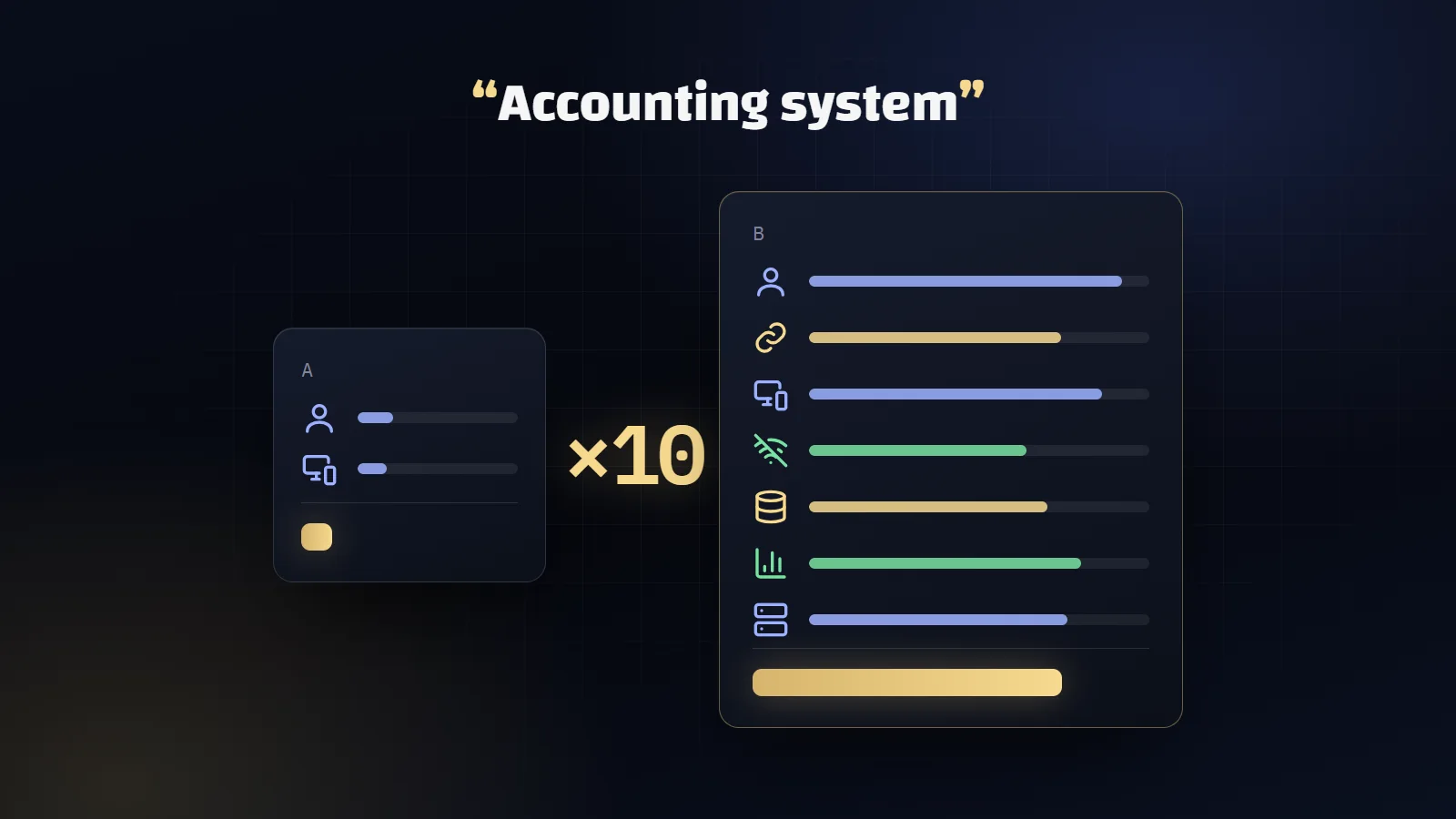
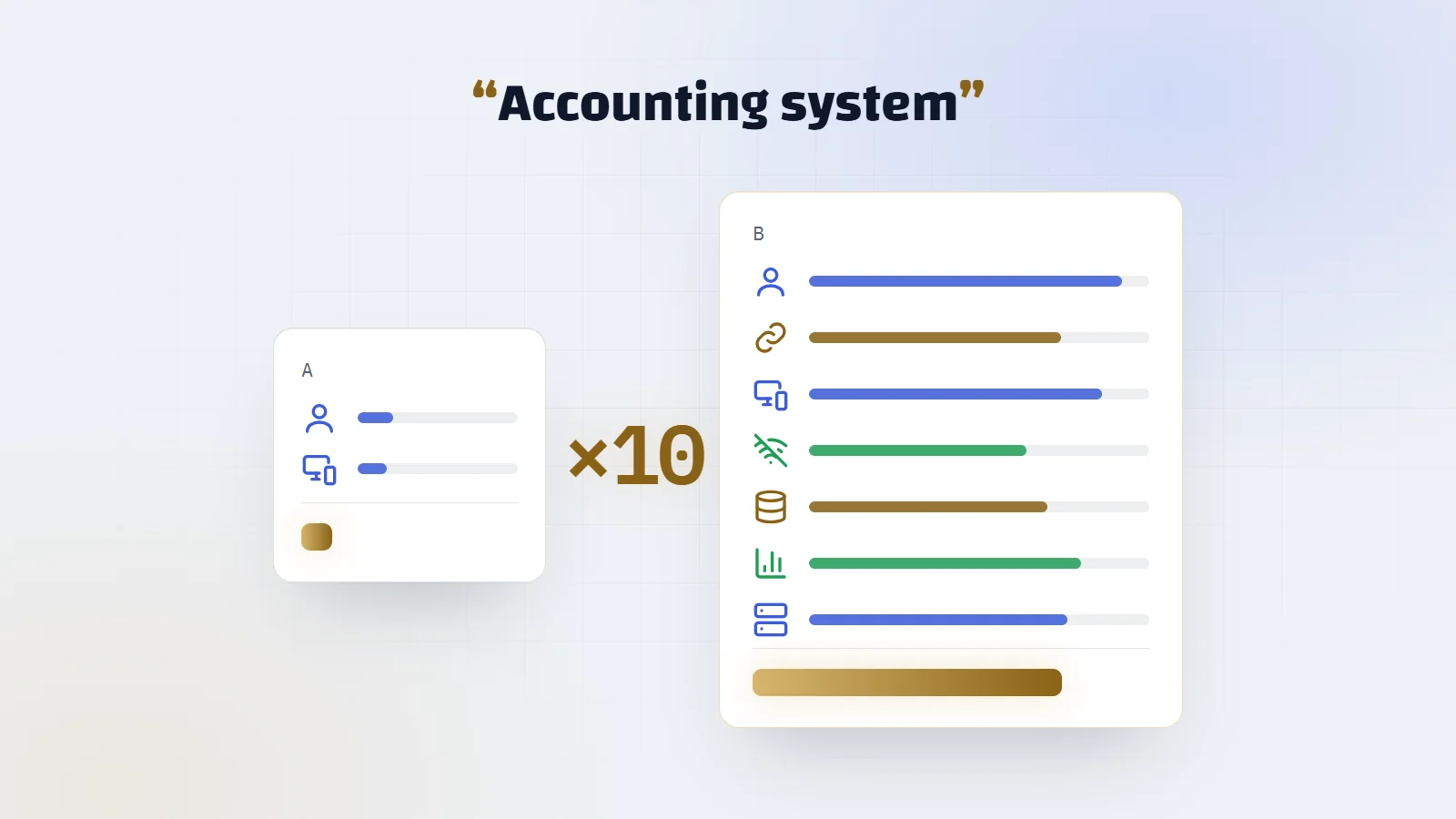
"An accounting system" can mean a spreadsheet with a login. It can also mean FinyX-ERP, my accounting and point-of-sale product: around twenty modules, about 322,000 lines of code and more than 530 automated tests. A campaign website I built this year has about 3,100. Both were real work, and they are not the same size. Size is what you pay for.
By the end you will know the seven things that set the size of a custom system, how to tell which of them your business needs, how to read two quotes side by side, and how to fit a first version to your budget without buying less than you need.
In short
- The price follows the size of the system, and seven things set the size: roles, connections to other companies, platforms, working offline, old data, reports, and running it.
- Each of the seven can be small or large for your business. Before you compare two totals, ask which size each quote assumed.
- Phases fit the system to your budget. Fees paid to other companies come on top, and a good quote lists them.
The same words can describe very different systems
Ask three builders for the price of "a house" and you will hear numbers that differ tenfold, because a house can be one room or three floors. Software is the same. A developer prices the floor area: the screens, the rules behind each screen, the automated tests that check those rules, and the work of keeping it all running.
That is why I give no price before the first conversation. Three questions settle most of the size: who will use the system, what data matters, and who may do what. The rest comes from seven things, and each of them has a small version and a large one.
Two quotes that differ tenfold usually assumed different columns of this table. Here it is, row by row.
Every permission is a rule, a check and a test
The cheapest system lets everyone do everything. Few businesses can live with that. A cashier should not see cost prices, and a branch manager should not cancel another branch's invoice.
Each of those rules is three pieces of work. A check on the server, where the data actually changes, because hiding a button stops nobody who knows the address behind it. A screen that respects the rule. And an automated test, a small program that checks the rule every time the code changes.
On a network operations platform I built, the answer to "who may do what" became 49 permissions grouped into four roles, plus approval of each phone before it can sign in. FinyX-ERP has more than 80 permissions at three levels, the page, the action and the single field, across 16 built-in roles. Both are far from "two roles with full access", and they cost accordingly.
Tip
Before you ask for quotes, write a table: your staff roles down the side, the sensitive actions across the top (cancel, discount, refund, see costs, export). Send the same table to every developer. Their quotes become comparable.
Each connection to another company is a small project
Taking card payments, sending WhatsApp messages, pulling products from a Salla store: each looks like one line in a list of features. Each is a small project with its own documents, test environment, approval steps and ways to fail.
FinyX-ERP takes payments through Moyasar, including Apple Pay. On Al-Marasim's ordering site, each order reaches the chosen branch on WhatsApp through Meta's WhatsApp Cloud API, with a simple WhatsApp link as a fallback. An AI marketing platform I built connects to Salla stores and publishes to Meta and TikTok, and it verifies the signature on every message those platforms send back, so nobody can fake one.
The time goes into what happens when something fails halfway: a payment that went through but whose confirmation never arrived, or a message the other side refused. A quote that says "payment gateway" without a word about those cases has priced only the easy part.
Each platform is another product to build, publish and update
A website works on every phone and computer with nothing to install. A phone app has to be built for Android and iOS, reviewed by Google and Apple, and updated through their stores. A Windows program needs an installer and a digital signature so the computer trusts it.
FinyX-ERP is a Windows program for the shop, and its online platform adds a web store, a staff and kitchen portal, and three phone apps: for customers, drivers and managers. FinyxWatt is four apps on one server: one for station staff, one that turns an Android phone into a text-message gateway, a console for running the platform, and one for subscribers.
Shared code helps: FinyX's desktop program and its online server are built from the same business rules, so a rule is written once. But every screen still has to be built and tested on each platform.
So ask whether your customers need an app, or whether a page that works well on a phone will do. Field apps often start on Android alone.
Working offline changes the design, so decide it first
A system that needs the internet stops when the internet stops. In a shop, that means the till stops. At an electricity station that often loses its network, it means nobody can record a payment.
FinyxWatt's station app never waits for the network. Every reading and payment is saved on the phone first, then sent to the server in order when the connection returns. Each one carries its own id from the moment it is saved, so a payment sent twice is recorded once. The technical story is here.
None of that is a feature you add at the end. Working offline decides how data is stored, how two changes to the same record are settled, and how duplicates are refused. Added to a finished system, it is close to a rewrite, so it belongs in the first conversation.
Old data and reports are work you can count
If five years of customers live in a spreadsheet, moving them is a task with its own estimate: map the columns, clean the duplicates, import a trial copy for your team to check, then switch. On an ordering platform for a clothing retailer, stock arrives from Excel files through an import built for exactly that.
Moving a live system's data can be a project of its own. When I moved FinyxWatt from Firebase to a database on its own server, it took 107 ordered and verified database migrations, small scripted steps that each change the shape of the data, with the stations working throughout.
Reports are easier to count. Each one is a query, a screen and usually an export to Excel or PDF. The network operations platform has 19 report types for owners and managers. Ask your team which reports they open every week, build those first, and let the rest wait for a later phase.
Running it is part of the price, and some of it is paid to others
A system that works on launch day needs care every day after: backups that are tested by restoring them, security updates, releases that can be undone, and someone who answers when something breaks. On the network operations platform, the client received that work as scripts with the code: server setup, deployment, rollback, encrypted backups and backup checks. My sample proposal includes three months of support after the final handover.
Some running costs are not paid to your developer at all. The server and the domain, a WhatsApp Business account, the app stores: each is paid to another company. As of October 2026, Apple charges 99 US dollars a year for a developer account, and Google Play charges a one-time 25 dollars. Payment gateways take a share of each payment, and WhatsApp charges for certain kinds of message.
None of this should surprise you later. A good quote lists it under "not included".
Fit the budget with phases, not with a smaller system
When the price is above your budget, there are two ways down. One is a cheaper quote for a smaller system under the same name: fewer rules, no tests, no tested backups. You learn which parts were left out after launch, when they cost the most to add. The other is phases: the same system, built in steps, each step useful on its own.
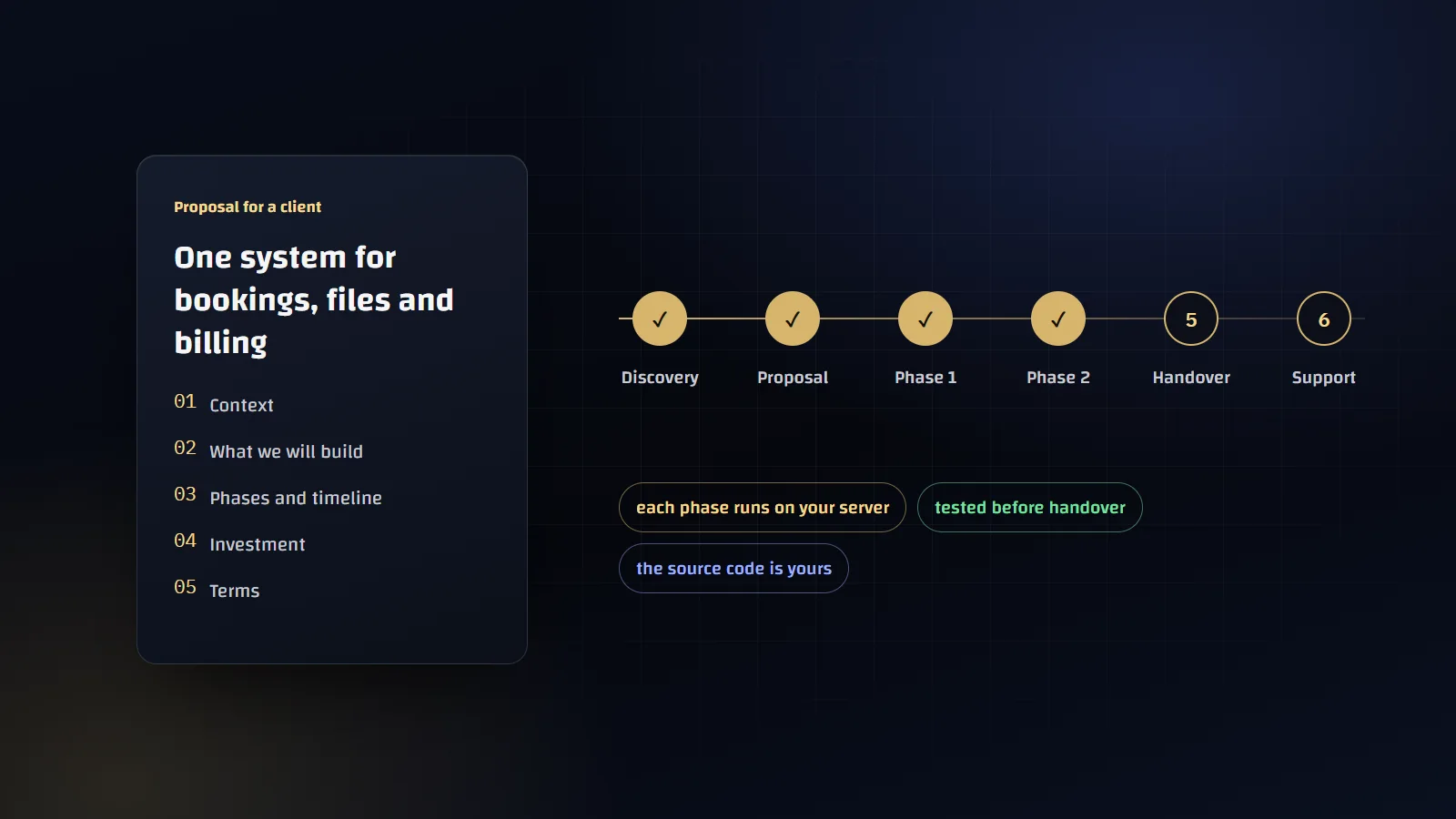
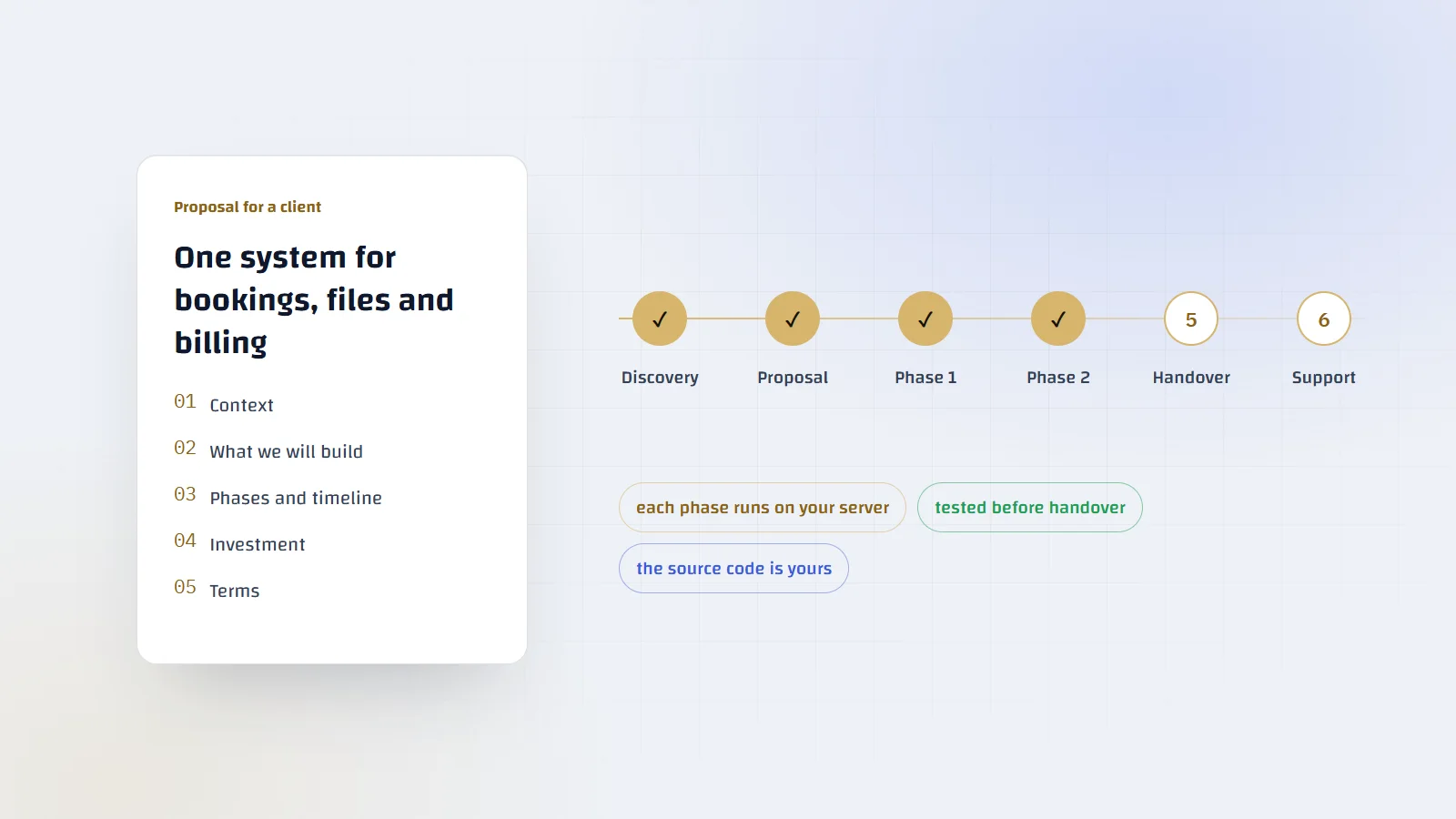
This is the shape of the sample proposal I keep as a template, priced for an imaginary clinic:
| Phase | What is delivered | Duration | Price |
|---|---|---|---|
| 1. Foundation | Appointments, the patient file, and permissions | 5 weeks | 18,000 SAR |
| 2. Billing | The invoice from the visit, the link to accounting, reports | 4 weeks | 14,000 SAR |
| 3. Patient app | Booking and reminders on Android and iOS | 3 weeks | 12,000 SAR |
| Total | 12 weeks | 44,000 SAR |
Those numbers are a sample, not a price list: your system is priced from its own answers to the seven questions. What the sample shows is the shape. Each payment is due when its phase starts, so the clinic pays for a working foundation first, uses it on its own server, and then decides whether billing still comes next.
Notice what phase one keeps: permissions. Phases cut screens. They never cut the foundations.
- Phase 1, weeks 1 to 5appointments, patient files and permissions, live on the clinic's server
- Phase 2, weeks 6 to 9billing from the visit, the link to accounting, reports
- Phase 3, weeks 10 to 12the patient app on Android and iOS
- After handoverthree months of support
Checklist: read two quotes side by side
Send every developer the same questions, and ask for the answers in writing.
- Who will use the system, and how many roles and permissions does the quote assume?
- Which connections to other companies are included: payments, WhatsApp, SMS, a store platform?
- Which platforms: web only, or also Android, iOS and Windows?
- Will it keep working when the internet drops?
- Is importing your old data a line of its own, with a trial import your team checks?
- Which reports are included, by name?
- Are automated tests, tested backups and deployment on your server included?
- How long is support after handover, and what does it cover?
- Which fees to other companies are listed as not included?
- Is the work split into phases, each with its price and what it delivers?
Two honest quotes can differ tenfold. Once both answer the same questions in writing, you are comparing two systems instead of two numbers.
You can see how I scope and build these systems on my business systems page.
Share